








What is the Motor Strength Scale?
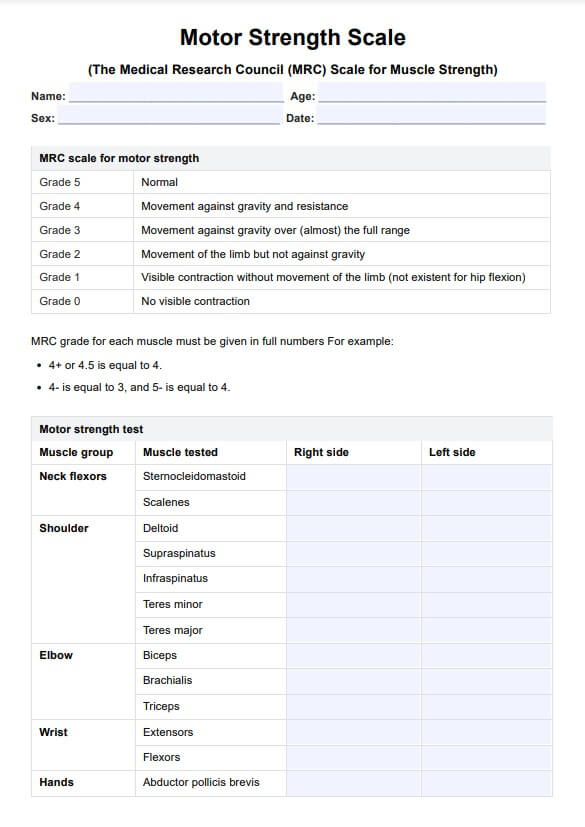
The Motor Strength Scale, or the Medical Research Council (MRC) Scale for Muscle Strength, assesses motor strength on a scale of 0 to 5, with 0 being no muscle movement and 5 being normal strength. The scale uses the following motor strength grading system:
- Grade 5: Normal
- Grade 4: Movement against gravity and resistance
- Grade 3: Movement against gravity over (almost) the full range
- Grade 2: Movement of the limb but not against gravity
- Grade 1: Visible contraction without movement of the limb (not existent for hip flexion)
- Grade 0: No visible contraction
Typically used in manual muscle testing or muscle strength testing, this muscle testing tool can be used by healthcare providers to determine if there is any weakness or loss of muscle function in both upper and lower extremities, which may be a sign of an underlying medical condition (e.g., weak motor strength in the hip suggests pelvic girdle weakness and weak shoulder motor strength suggests shoulder girdle weakness.
The MRC Scale is widely used in medical settings and has been found to be a reliable and valid measure for assessing motor strength (Paternostro-Sluga et al., 2008). It can also be adapted for use in different populations, such as children or individuals with neurological conditions.
While this Motor Strength Scale primarily assesses voluntary muscle movement, it can also help identify potential areas of weakness that may require further investigation or treatment. Additionally, the scale can be useful for tracking progress in patients undergoing rehabilitation or physical therapy.









