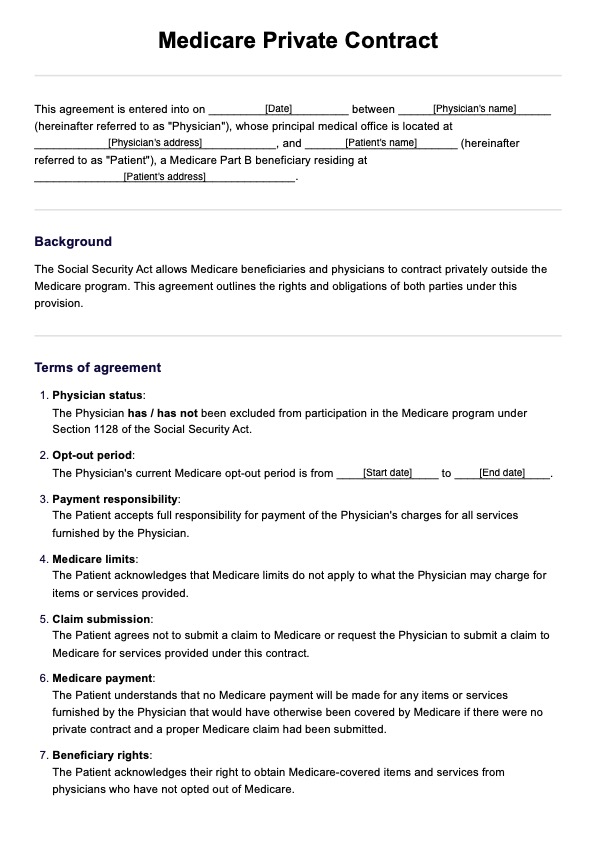
What should be in the private contract?
While there isn't a standardized Medicare private contract form, the Centers for Medicare & Medicaid Services (CMS) outlines specific requirements in federal regulations that all such contracts must meet (Centers for Medicare & Medicaid Services , 2016). These include:
Identification and introduction
The contract section lists the complete names and contact details of the healthcare provider and the Medicare beneficiary, including full names and contact information.
Scope and terms of services
This section describes the healthcare provider's medical services or treatments under the contract. It should include details about the types of services, frequency, and limitations.
Financial arrangements
Here, the contract delineates the financial aspects, such as the fees charged for the services provided, whether payment will be made out-of-pocket or through supplemental insurance, and the agreement by the provider not to bill Medicare.
- Payment terms: Clearly outline the financial arrangements, including the services' fees. Specify whether payment will be made out-of-pocket by the beneficiary or through supplemental insurance.
- Waiver of Medicare payment: The contract should state that the healthcare provider agrees not to bill Medicare for any services provided to the beneficiary under the terms of the contract.
- Responsibility for payment: Specify that the Medicare beneficiary agrees to assume full responsibility for payment of the services received under the contract, including any charges that exceed the Medicare fee schedule.
Understanding of Medicare coverage
This section aims to educate the beneficiary about the restrictions of Medicare coverage for services rendered by a non-participating provider who has chosen to opt out of Medicare.
Duration and termination
The duration of the contract should be clearly defined, including the contract’s effective date and the agreed-upon period for which the agreement will remain in force. Typically, the contract may last for a specified period, such as two years, unless otherwise stated.
Additionally, the contract must outline the circumstances under which it may be terminated before the specified duration ends. It should include provisions for early termination, whether initiated by the physician or the beneficiary or due to other specified conditions, providing clarity on the procedures and any necessary notice periods. This ensures both parties are fully aware of their rights and responsibilities should they wish to terminate the agreement before its expiration.