Scoring and interpretation
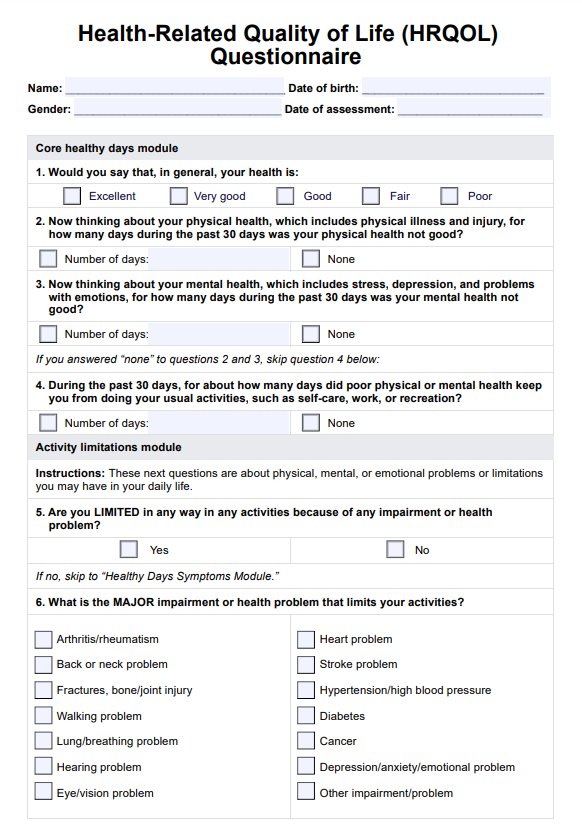
The HRQOL Questionnaire provides scores that help assess the overall health-related quality of life. The scoring system includes the core healthy days, activity limitations, and healthy days symptoms modules, each contributing to understanding the patient's physical and mental health (.
Core healthy days module
The core healthy days module assesses the patient's perceived overall health (Q1) and the number of days in the past month affected by physical (Q2), mental (Q3), or overall health problems (Q4). Lower scores in Q1 indicate poorer perceived health, while higher numbers in Q2, Q3, and Q4 indicate more days of health issues. These scores help gauge the frequency of physical and mental health challenges experienced by the patient.
Activity limitations module
The activity limitations module identifies if health problems limited the patient’s activities (Q5) and specifies which conditions caused these limitations (Q6). A “yes” response to Q5 indicates activity restrictions, while the specific health problems listed in Q6 provide further context. Q7 allows for additional details on limitations, offering a clearer understanding of how health conditions impact daily functioning.
Healthy days symptoms module
To calculate the unhealthy days score, sum the number of physically unhealthy (Q2) and mentally unhealthy days (Q3), with a maximum possible score of 30 days. The healthy days score is then derived by subtracting the unhealthy days from 30. Higher healthy days scores indicate better overall health, while more unhealthy days signal a greater impact of physical and mental health issues on the patient’s life.
The HRQOL scores provide a comprehensive view of a patient's health status. A higher number of healthy days indicates better overall health, while more unhealthy days signal a higher burden of physical and mental health issues. Activity limitations and the specific conditions causing those limitations are also important in understanding the full scope of the patient's health challenges. This information helps healthcare providers tailor treatment plans and interventions to improve the patient's quality of life.