Everyone has a story to tell, and here we share and celebrate those who chose care as their life's work.
These are their words, their work and we're grateful to share them.
Elizabeth and Dennis handed their billing to Carepatron and grew My Therapeutic Concepts from five clients to seventy in two months, without losing their evenings.
## **Benefits of delayed gratification for mental health**
Delayed gratification is a crucial skill that can significantly impact mental health and overall well-being. Delaying gratification involves choosing to postpone pleasure or forgo an immediate reward instead of a potentially greater long-term reward. This concept, popularized by the famous marshmallow experiment conducted by psychologist Walter Mischel, has been extensively studied in psychological science (Mischel et al., 1972). The findings consistently highlight the significant benefits of developing this skill.
One of the primary advantages of cultivating the ability to delay gratification is improved emotional regulation. Individuals who can resist immediate pleasure often demonstrate better stress management and resilience in life's challenges (Luerssen & Ayduk, 2014). This enhanced self-regulation and impulse control can lead to reduced anxiety and depression symptoms as people feel more in control of their responses to stressors in their everyday life.
## **5 examples of delayed gratification exercises**
Developing the ability to delay gratification is a crucial skill that can significantly impact various aspects of life, from health and finances to personal relationships and career success.
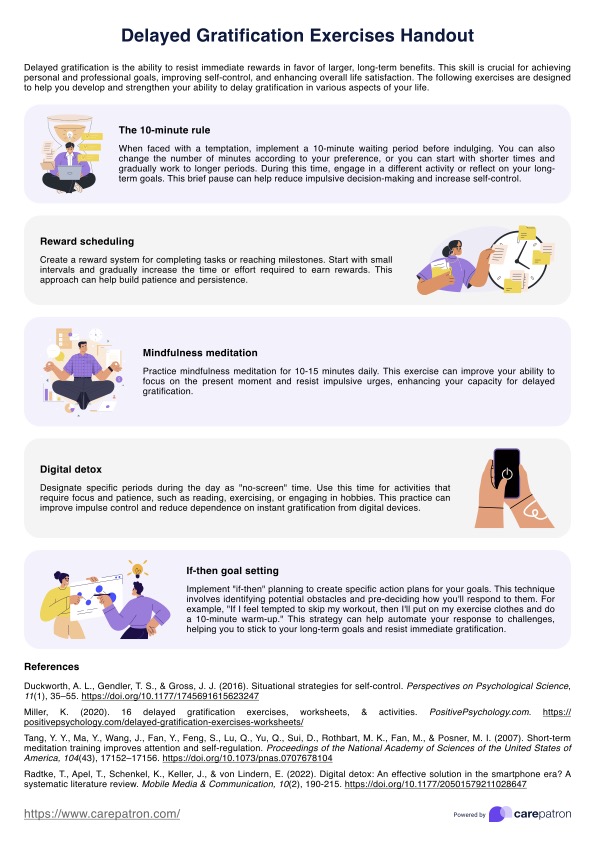
Here are five practical exercises that can help individuals in mastering self-control and resisting the pull of instant gratification:
### **The 10-minute rule**
This exercise can be particularly effective for clients struggling with impulse control or instant gratification. By implementing a waiting period, clients can create a buffer between the impulse and action, allowing time for more rational decision-making. This technique can be especially useful for those dealing with issues like overeating, compulsive shopping, or substance use.
### **Reward scheduling**
This approach leverages the power of immediate rewards to build towards long-term success. It can be particularly beneficial for clients working on complex or long-term goals that might otherwise feel overwhelming or unrewarding in the short term.
For instance, clients aiming to lose weight might reward themselves with a relaxing bath or a new book after a week of consistent exercise rather than using food as a reward.
### **Mindfulness meditation**
Mindfulness practices can significantly enhance clients' ability to resist temptation and make smarter choices. By improving present-moment awareness, mindfulness can help clients recognize and manage impulses more effectively. You can introduce simple mindfulness exercises during sessions and encourage daily practice at home.
### **Digital detox**
In our increasingly connected world, the constant availability of digital stimulation can make it challenging to develop delayed gratification skills. This could involve creating "phone-free" zones in the home or setting device app limits. Such practices can help clients rediscover the satisfaction of long-term rewards from more engaging, less instant activities.
### **If-then goal setting**
This strategy, or implementation intentions, can be a powerful tool for helping clients overcome obstacles to their long-term goals. Pre-planning responses to potential challenges help clients reduce the cognitive load required to make decisions at the moment, making it easier to resist immediate pleasure in favor of long-term success.
## **How does our Delayed Gratification Exercises Handout work?**
The Delayed Gratification Exercises Handout is a valuable tool for healthcare practitioners to help clients develop self-control. Here's a step-by-step guide on how to effectively implement this resource in your practice:
### **Step 1: Introduce the concept and assess client needs**
Click "Download" to get the PDF copy of the handout on this page, or click "Use template" to edit it within the Carepatron platform before printing or sending it to clients.
Then, begin by explaining the importance of delayed gratification to your client. Discuss how this skill can lead to better decision-making, improved self-regulation, and greater success in achieving long-term goals. Assess which areas of the client's life could benefit most from enhanced impulse control.
### **Step 2: Select appropriate exercises**
Work with your clients in choosing one or two exercises from the delayed gratification worksheet PDF to focus on initially. Walk your client through the selected exercise(s) during your session. For instance, if the 10-minute rule is used, role-play scenarios where the client might face temptation and practice the waiting period. Encourage them to apply the technique in real-life situations between sessions.
### **Step 3: Follow up and adjust**
In subsequent sessions, review the client's experience with the exercises. Discuss challenges faced and successes achieved. Based on this feedback, adjust the approach as needed. This might involve modifying the exercise, trying a different technique, or gradually increasing the difficulty level as the client's self-control improves.
## **How this handout may benefit mental health professionals**
The Delayed Gratification Exercises Handout is a valuable resource for mental health professionals working with clients to improve their self-control and decision-making skills. These skills are particularly relevant in today's fast-paced world, where the pleasure principle often drives impulsive behaviors.
Here's how this handout can benefit mental health professionals in various aspects of their practice:
### **Enhanced treatment strategies**
The exercises in this handout provide practical tools for addressing impulse control issues, which are common in many mental health conditions.
For instance, clients struggling with substance abuse can benefit from techniques like the 10-minute rule or mindfulness meditation to manage cravings and resist immediate gratification.
### **Development of emotional regulation skills**
Exercises like mindfulness meditation and digital detox can significantly improve clients' emotional regulation abilities. These practices help individuals become more aware of their thoughts and feelings, reducing reactivity to immediate stimuli.
For clients dealing with anxiety, depression, or stress-related disorders, these exercises can serve as valuable coping mechanisms
### **Reinforcement of long-term thinking**
The concept of delayed gratification, symbolized by the famous "second marshmallow" in Walter Mischel's Marshmallow Test, is central to many aspects of mental health and well-being. This can help clients develop a more future-oriented mindset.
This shift in perspective can be particularly beneficial for clients working on building healthier habits such as how to save money and better adhere to health behaviors. This can even empower clients to plan about their future career and goals.
## **References**
Luerssen, A., & Ayduk, O. (2014). The role of emotion and emotion regulation in the ability to delay gratification. In J. J. Gross (Ed.), Handbook of emotion regulation (2nd ed., pp. 111–125). The Guilford Press. https://psycnet.apa.org/record/2013-44085-007
Mischel, W., Ebbesen, E. B., & Raskoff Zeiss, A. (1972). Cognitive and attentional mechanisms in delay of gratification. Journal of Personality and Social Psychology, 21(2), 204–218. https://doi.org/10.1037/h0032198
Commonly asked questions
Delayed gratification activities include tasks that require individuals to postpone immediate rewards in favor of larger, long-term benefits. Examples of ways to practice delayed gratification through activities include saving money for a significant purchase instead of spending it impulsively, studying for an exam rather than engaging in leisure activities, and practicing a skill consistently over time to achieve mastery.
Teaching delayed gratification involves modeling self-control strategies and providing opportunities for practice. Parents and educators can help individuals practice self-control, more specifically, encourage children to wait for rewards by introducing games that require patience, such as waiting for a treat after completing a chore or task. Additionally, discussing the benefits of delayed gratification and helping individuals set long-term goals can reinforce the importance of patience.
Exercising delayed gratification can lead to numerous benefits, including improved self-control, better decision-making skills, and enhanced emotional regulation. Developing the ability to delay gratification helps individuals cultivate patience and persistence in various aspects of life.