









What is a closed kinetic chain exercise?
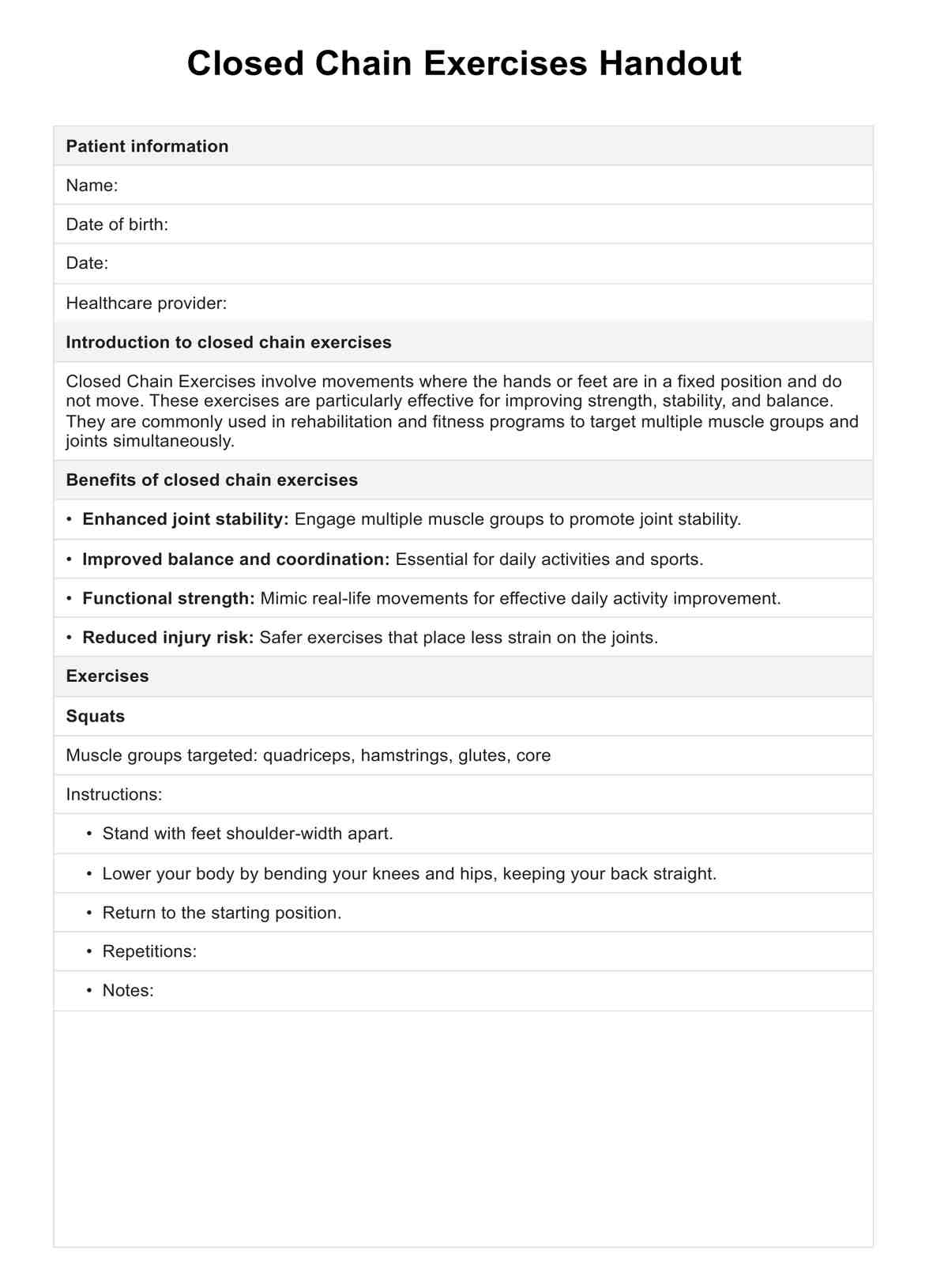
Closed kinetic chain (CKC) exercises, also known as closed chain exercises, involve movements in which the hands or feet remain in a fixed position while the body moves around them. These compound exercises simultaneously involve multiple muscle groups and joints, promoting strength, stability, and coordination. Common examples include squats, push-ups, and lunges.
Closed chain exercises are often used in rehabilitation and fitness programs to enhance functional movement patterns, reduce the risk of injury, and improve overall physical performance.
How do they differ from open kinetic chain exercises?
Open and closed kinetic chain exercises differ from open-chain exercises in several vital ways. In closed chain exercises, the distal end of the limb (hand or foot) is fixed, activating multiple muscle groups and joints. This type of exercise typically enhances joint stability and functional strength. For example, during a squat, the feet remain in contact with the ground, and multiple joints (hips, knees, and ankles) work together to perform the movement.
Conversely, open-chain exercises involve movements where the distal end of the limb is free to move. These exercises often isolate a single muscle group or joint, allowing for targeted muscle activation patterns strengthening. Examples of open kinetic chain movements include leg extensions and bicep curls, where the foot or hand moves freely while performing the exercise. Open-chain exercises benefit isolated muscle strengthening but may place more stress on individual joints than closed-chain exercises.









