





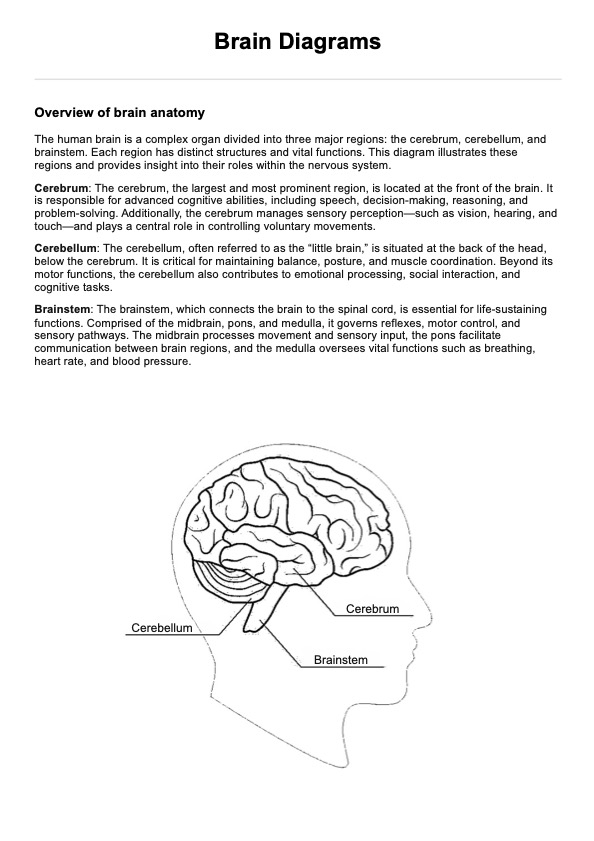




What is a Brain Diagram?
All practitioners who have gone through medical and nursing school are undoubtedly familiar with the central nervous system, particularly the brain and spinal cord. However, for a refresher, the Brain Diagram is an illustration that helps practitioners learn more about the brain structure and the names and corresponding locations of the different parts of the brain.
The appearance of a Brain Diagram can vary depending on its source or purpose. Diagrams may depict the brain from a top or side view, emphasizing its external or internal parts. The level of detail can be tailored to the practitioner's specific requirements, ranging from a general overview to a more intricate representation, which might extend to the brain's connection with the peripheral nervous system.
Brain Diagrams are helpful mostly to students. And though that is true, it can also be helpful to medical professionals. We prepared a Brain Diagram complete with an illustration of the brain and the corresponding labels for each part. We've also included a dedicated space for any notes you may have for yourself or your patient.









