
Healthcare providers conduct a comprehensive evaluation to diagnose global developmental delay, including a detailed medical history, physical examination, and developmental assessment. Standardized developmental screening tools measure a child's skills across multiple domains, such as cognition, language, motor, social-emotional, and adaptive functioning. If delays are identified, further testing, such as genetic analysis, neuroimaging, and metabolic screening, may be ordered to determine the underlying cause.
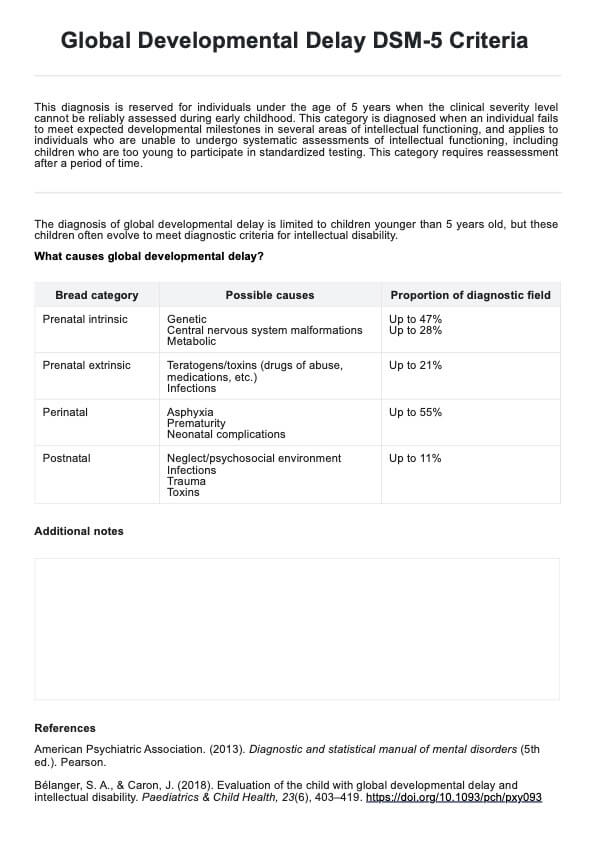



Global Developmental Delay DSM-5 Criteria
Access a reference tool for pediatric clients with our Global Developmental Delay DSM-5 Criteria resource.

Use Template
Global Developmental Delay DSM-5 Criteria Template
Commonly asked questions
Global developmental delay is not a form of autism, but the two conditions can co-occur. While autism is a specific neurodevelopmental disorder characterized by challenges in social communication and the presence of restricted repetitive behaviors, GDD refers to a general delay in the acquisition of developmental milestones across multiple domains.
In some cases, children with global developmental delay may be able to "outgrow" their delays as they receive early intervention services and their development progresses, though the degree of catch-up can vary. However, many children with GDD will continue to experience lifelong intellectual and adaptive functioning challenges, requiring ongoing support and specialized educational programming.










EHR and practice management software
Get started for free
*No credit card required
Free
$0/usd
Unlimited clients
Telehealth
1GB of storage
Client portal text
Automated billing and online payments