
ESV and EDV, or end-systolic and end-diastolic volumes, play pivotal roles in understanding cardiac function. The end-diastolic volume (EDV) signifies the blood amount in the ventricle at the end of ventricular diastole or filling. In contrast, the end-systolic volume (ESV) represents the blood remaining in the ventricle after ventricular systole or ejection. The stroke volume, obtained by subtracting ESV from EDV, is a crucial parameter for calculating cardiac output (Martini et al., 2017, 686).
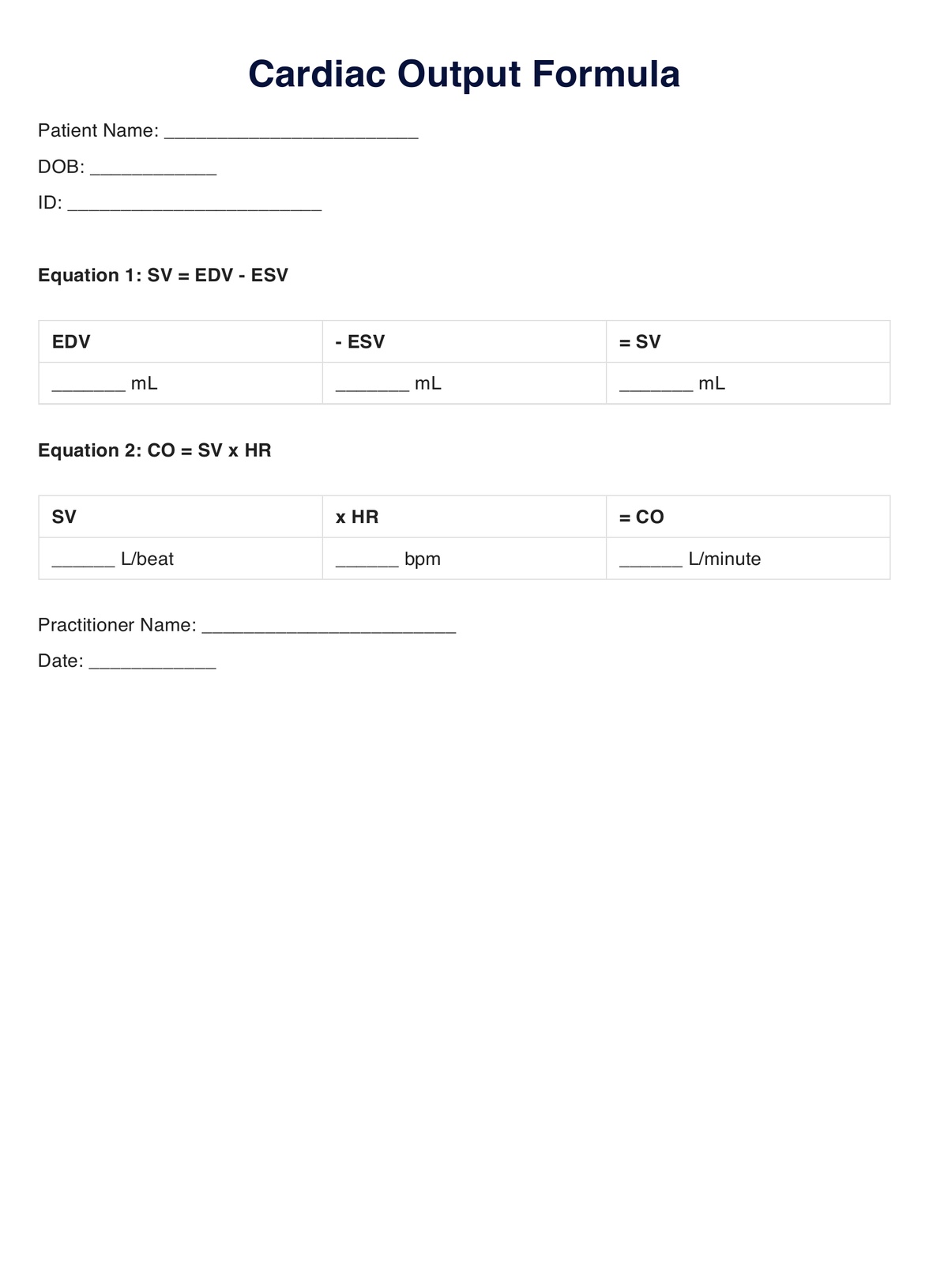



Cardiac Output Formula
For those moments when the equation eludes you, our Cardiac Output Formula worksheet will ensure your calculations are accurate every time.

Use Template
Cardiac Output Formula Template
Commonly asked questions
Various cardiac output formulae exist, ranging in complexity. The formula discussed here is among the simplest, applicable when stroke volume, or EDV and ESV, are known. Different formulae cater to specific techniques like thermodilution or Fick cardiac output calculation, each requiring a distinct set of parameters.
In terms of efficiency, this particular cardiac output formula stands out as one of the quickest and simplest methods for estimating cardiac output. If you have the stroke volume, measuring the patient's heart rate and plugging the numbers into the formula involves just a couple of straightforward calculations, providing you with the cardiac output efficiently.










EHR and practice management software
Get started for free
*No credit card required
Free
$0/usd
Unlimited clients
Telehealth
1GB of storage
Client portal text
Automated billing and online payments