
The Apley’s Test is used to assess meniscal injuries and differentiate them from ligamentous injuries in the knee joint. It helps determine whether a patient’s knee pain and mechanical complaints are due to a meniscal lesion or ligament damage. This test is often performed when a patient experiences locking, clicking, or restricted movement in the knee.
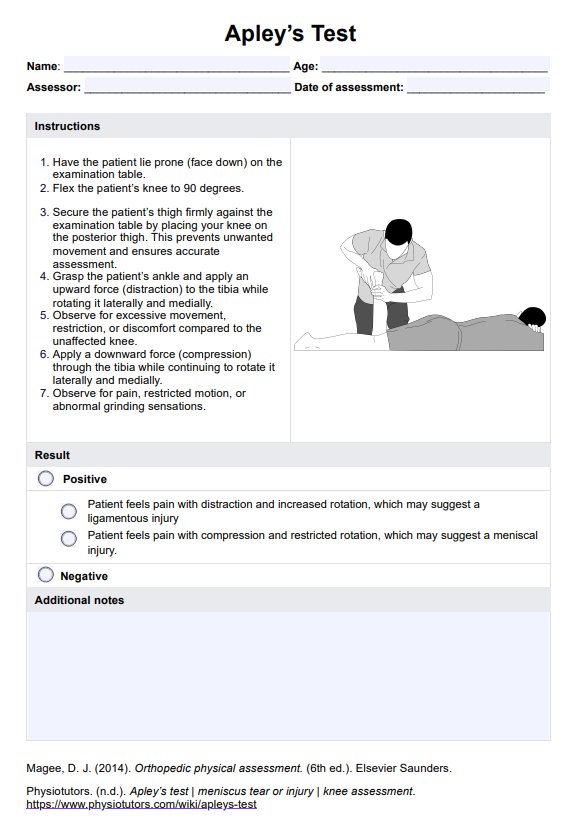



Apley's Test
Learn how the Apley's Test works. Get access to a free template for streamlined clinical documentation.

Use Template
Apley's Test Template
Commonly asked questions
The Apley’s Test measures pain response, joint mobility, and rotational restrictions in the knee to evaluate potential meniscus injuries or ligamentous instability. If pain occurs during compression, it suggests a meniscal lesion, whereas pain during distraction indicates possible ligamentous involvement.
To perform the Apley grind test, the patient should be positioned in a prone position with their knee flexed to 90 degrees. Stabilize the posterior thigh against the table, then apply downward compression to the tibia while rotating it medially and laterally to assess the meniscus. Repeat the movement with distraction by pulling the tibia upward to evaluate ligamentous structures, noting any pain or restricted motion.










EHR and practice management software
Get started for free
*No credit card required
Free
$0/usd
Unlimited clients
Telehealth
1GB of storage
Client portal text
Automated billing and online payments