



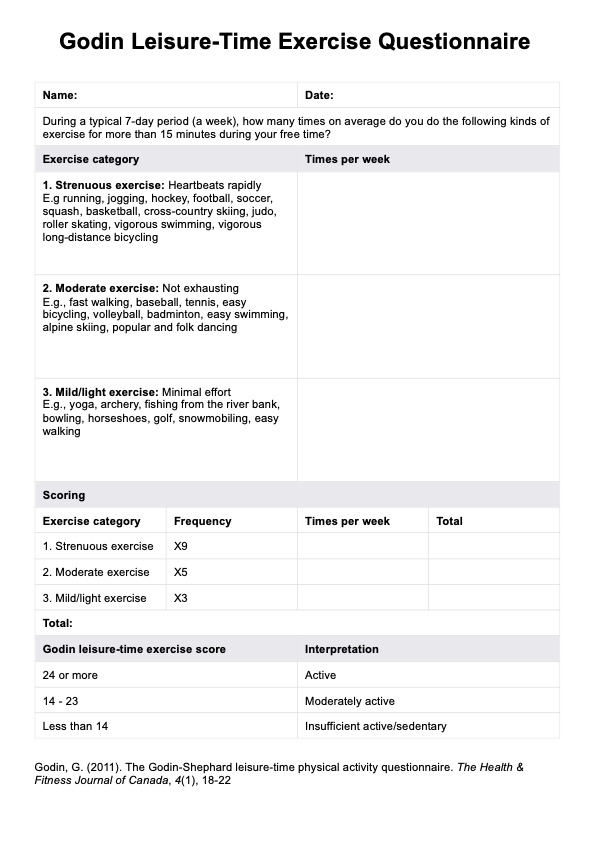



What is the Godin Leisure-Time Exercise Questionnaire?
The Godin Leisure-Time Exercise Questionnaire measures self-reported physical activity among adults to assess exercise behavior (Zelener & Schneider, 2016).
Leisure-time physical activity (LTPA) is a subtype of physical activity; LTPA refers to activity that is typically voluntary and of higher intensity, unlike habitual physical activity, which includes routine exercise such as occupational, commuting, and household physical activity. LTPA is proven to be beneficial for cancer survivors' mental and physical health (Godin, 2011).
The Godin Leisure-Time Exercise Questionnaire is a commonly used physical activity questionnaire in research assessing physical activity in patients with chronic diseases, such as multiple sclerosis (Sikes et al., 2019). It primarily focuses on physical activity performed outside of occupational or household settings, clearly understanding an individual’s voluntary leisure-time physical activity.
Respondents are asked to indicate, on average, during a typical week do, they do the three subscales of exercise for more than 15 minutes. The subscales are listed below:
- Strenuous exercise: heart rapidly beats, e.g., running, vigorous swimming, basketball, football.
- Moderate exercise: not exhausting: e.g., fast walking, badminton, easy swimming, volleyball
- Mild/light exercise: minimal effort: e.g., yoga, bowling, golf, easy walking
, Respondents are placed into one of three categories based on their physical activity level: active, moderately active, and insufficiently active. There is significant valid evidence supporting the use of the Godin Leisure-Time Exercise Questionnaire to classify healthy adults into these categories based on their physical fitness (Godin, 2011). These categories follow guidelines supported by public health, health-related research, and health promotion.









