



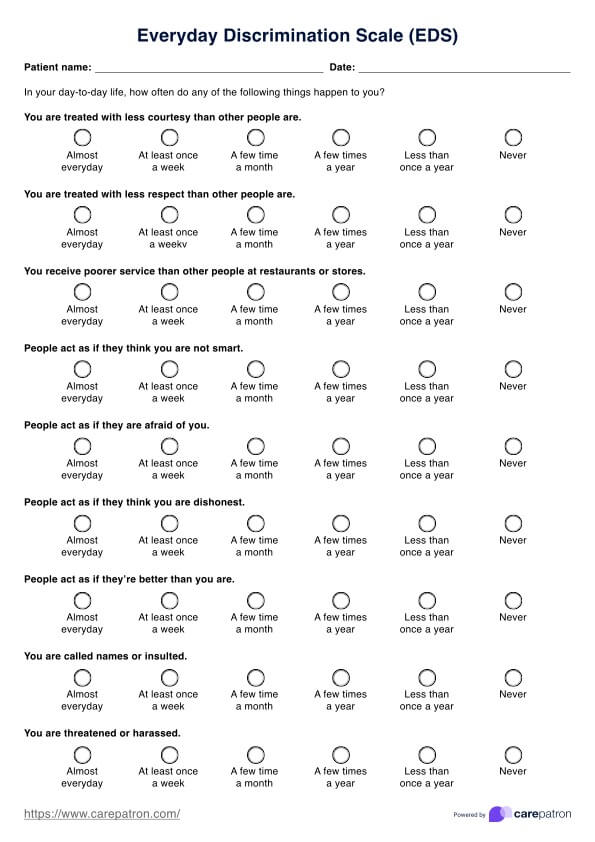




What is the Everyday Discrimination Scale (EDS)?
The Everyday Discrimination Scale (EDS) is a widely recognized self-reported health tool designed to assess perceived discrimination in various daily contexts. This self-report measure evaluates how individuals experience and perceive unfair treatment due to their racial/ethnic background, gender discrimination, sexual orientation, or socioeconomic status. This tool helps identify the impact of on individuals seeking higher education or navigating other life domains.
While the EDS was developed as a social science instrument to capture nuanced experiences of discrimination, the EDS offers insights into how these experiences can impact both physical and mental health. Since the EDS focuses on perceived discrimination, it reflects how individuals interpret and react to everyday instances of unfair treatment. This measure is crucial in health psychology and behavioral medicine as it helps uncover the links between discrimination and health. By assessing perceived racial discrimination and other forms of bias, the EDS provides valuable data on mental health correlates of discrimination.
The EDS has been used in health-related studies like the National Survey of American Life to explore the relationship between discrimination and health outcomes. It sheds light on how discrimination experiences are related to poorer service, mental health issues, and physical health concerns.









