


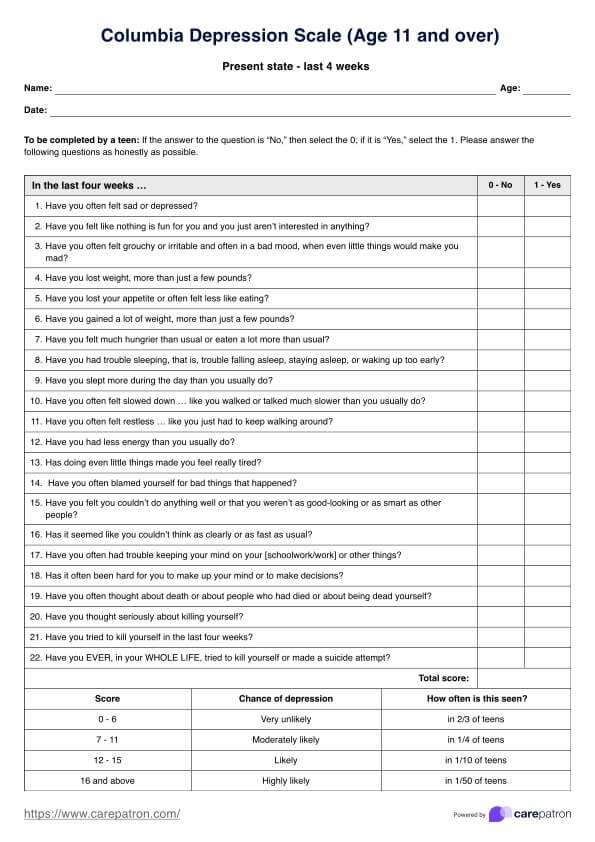




What is the Columbia Depression Scale?
The Columbia Depression Scale (CDS) is an important tool for spotting depression in children and adolescents aged 11 and up. Originally developed by experts at Columbia University, the CDS was created to address the need for reliable and effective screening tools for mental health conditions like depression in younger age groups, such as high school students.
It consists of 22 yes/no questions that cover symptoms like:
- Feelings of sadness or depression
- Loss of interest in activities
- Irritability and bad mood
- Changes in appetite and weight
- Sleep disturbances
- Fatigue and low energy
- Feelings of worthlessness or guilt
- Difficulty concentrating
- Suicide risk and attempts
The Columbia Depression Scale is a screening tool completed by both the adolescent and a parent/caregiver. The adolescent (aged 11 and over) completes the 22 yes/no questions on the to self-report their symptoms of depression. There is also a parent version. This version also has 22 items but worded slightly differently from the teen version and focus on the symptoms observed by the parent or caregiver.
What is the goal of the Columbia Depression Scale?
By using the CDS, healthcare providers can catch early warning signs, facilitate timely interventions, and ultimately improve mental health outcomes for young patients. This is especially important for addressing mental health disorders such as major depressive disorder or drug abuse problems.
The scale acts as a brief depression severity measure, which is crucial for adolescent primary care patients. Early identification can help prevent more severe mental disorders and reduce the risks associated with substance abuse. Furthermore, the CDS aligns with guidelines set by the preventive services task force, emphasizing its role in promoting proactive mental health care.
How is the CDS scored, and how are the results interpreted?
Here's how each version is scored and interpreted
Teen version
Each "No" response scores 0, and each "Yes" response scores 1. The total score ranges from 0 to 22, which is interpreted as follows:
- 0-6: Very Unlikely to have depression (seen in 2/3 of teens)
- 7-11: Moderately likely to have depression (seen in 1/4 of teens)
- 12-15: Likely to have depression (seen in 1/10 of teens)
- 16 and above: Highly likely to have depression (seen in 1/50 of teens)
Parent version
Scoring the parent version follows the same method: each "No" response scores 0, while each "Yes" response scores 1. However, the score is interpreted slightly differently:
- 0-4: Very unlikely to have depression (seen in 2/3 of teens)
- 5-9: Moderately likely to have depression (seen in 1/4 of teens)
- 10-12: Likely to have depression (seen in 1/10 of teens)
- 13 and above: Highly likely to have depression (seen in 1/50 of teens)
The scores from the teen and parent versions are then considered together to get a comprehensive assessment of the adolescent's depression risk. Higher scores on both versions indicate a greater likelihood of depression.









