








What is the Boredom Proneness Scale?
Boredom is an unpleasant mental state that arises from repetitive situations and a lack of cognitive engagement, significantly influencing human perception and behavior across different cultures.
Meanwhile, chronic boredom is linked with negative mood and depressive symptoms in adults (Lee & Zelman, 2019) and children, along with being recognized as a behavioral driver for negative outcomes, such as overeating (Abramson & Stinson, 1977) and alcohol consumption (Windle & Windle, 2018).
When managed effectively, boredom can also have positive effects by encouraging the search for new information and fostering exploration of one's environment (Bench & Lench, 2013). Individuals who feel half dead and dull or often trapped in situations where nothing seems to be passing may experience these effects more intensely.
Boredom can be categorized into state boredom, described as temporally limited experience of boredom, and trait boredom, considered as a rather stable individual proneness to be bored (Zerr, et al., 2024). The Boredom Proneness Scale can be used to apply trait boredom under healthy and pathological conditions (Zerr, et al., 2024), including among those with underlying mental health issues.
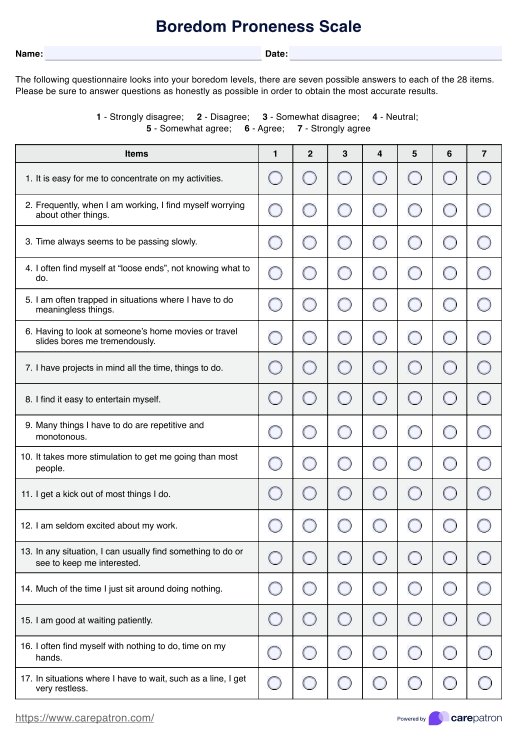
The Boredom Proneness Scale test (BPS) is a 28-item self-report measure of boredom proneness among an individual. Each item on the BPS assesses the following aspects of boredom (Farmer & Sundberg, 1986):
- Difficulty concentrating
- Feeling like time is passing slowly
- Feeling like life is boring
- Lack of interest in activities
- Feeling fidgety and restless
- Feeling like there is nothing to do
The items delve into topics such as waiting patiently, challenging things, same things, monotonous and tiresome situations, and someone's home movies. It also considers how an individual views themselves and their behavior; examples include whether they are seldom excited, a creative or imaginative person, whether they have free time due to their so many interests, and situations of both meaningless things and challenging things.
The scale helps identify whether someone is good at waiting patiently or whether they constantly seek more stimulation or a new idea to break the cycle of monotony.









