
The Marlowe-Crowne Social Desirability Scale (MCSDS) is a psychological assessment tool developed by Douglas P. Crowne and David Marlowe in 1960. It measures a person's tendency to respond in a socially desirable manner rather than truthfully, helping researchers control for response bias in self-reported data. The scale consists of 33 true-or-false questions designed to assess the extent of social desirability bias in an individual's responses.
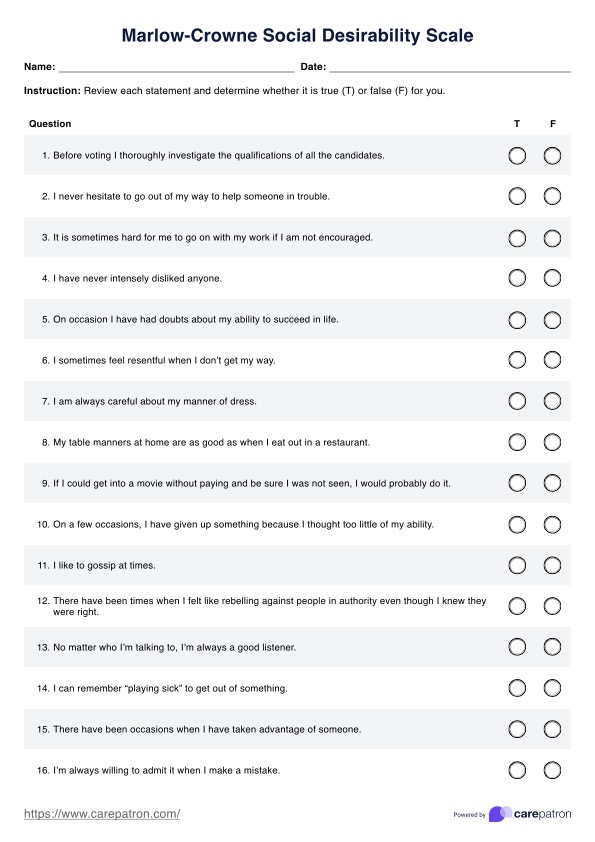



Marlowe-Crowne Social Desirability Scale
Explore the Marlowe-Crowne Social Desirability Scale, a key tool for researchers assessing socially desirable responses. Read the article to learn more.

Use Template
Marlowe-Crowne Social Desirability Scale Template
Commonly asked questions
A social desirability scale is a psychological instrument used to evaluate whether individuals answer questions truthfully or in a way that presents them in a more favorable light. It is commonly used in surveys and psychological assessments to identify response bias, ensuring more accurate data collection. The Marlowe-Crowne Social Desirability Scale (MCSDS) is one of the most widely used tools for measuring this bias.
Social desirability bias was originally developed as a concept by Alan Edwards, who identified it as a systematic source of test bias affecting self-reported responses. He argued that this bias could contaminate psychological assessments by influencing individuals to answer in ways that align with social approval rather than truthfulness.










EHR and practice management software
Get started for free
*No credit card required
Free
$0/usd
Unlimited clients
Telehealth
1GB of storage
Client portal text
Automated billing and online payments